

.png)
The Cowichan Valley Homeowner’s Guide to Stone
Retaining Walls
By Lennox Masonry — Cobble Hill, BC
Artisan stonemasons serving the Cowichan Valley
from our Cobble Hill location.
The Cowichan Valley is one of the most naturally beautiful regions on Vancouver Island — rolling terrain, mature trees, rural acreage properties, and a landscape that demands thoughtful management of slopes, grades, and water movement. For thousands of valley homeowners, a stone retaining wall is not just a landscaping feature — it is a structural necessity that holds back soil, manages drainage, defines usable outdoor space, and in many cases protects the home itself from slope movement.
Stone retaining walls are one of the most rewarding and most misunderstood elements of residential masonry. Done well, a stone wall integrates seamlessly into the Cowichan Valley landscape, lasts generations with minimal maintenance, and adds genuine property value. Done poorly — with inadequate drainage, incompatible materials, or insufficient foundation depth — a retaining wall fails progressively, sometimes suddenly, and replacement costs far exceed what proper construction would have cost originally.
This guide is written for Cowichan Valley homeowners considering a new stone retaining wall, dealing with an existing wall that is showing signs of failure, or simply trying to understand what they’re looking at and what their options are. Lennox Masonry builds and
repairs stone retaining walls across the full Cowichan Valley from our Cobble Hill location — from small garden walls to large structural retaining applications on rural acreage properties.
PART ONE: WHY STONE RETAINING WALLS SUIT THE
COWICHAN VALLEY
The Landscape
The Cowichan Valley’s terrain is characterised by rolling topography, significant rainfall, and a wide variety of soil conditions — from the rich agricultural soils of the valley floor to the rockier, more challenging ground on hillside properties around Shawnigan Lake, Cobble Hill, and the Malahat corridor. Many rural properties feature natural slopes that require management, and many older properties have existing walls — some well-built, many in need of attention — that were constructed decades ago without modern drainage considerations.
Why Stone Specifically
Stone is the natural material choice for the Cowichan Valley for several reasons:
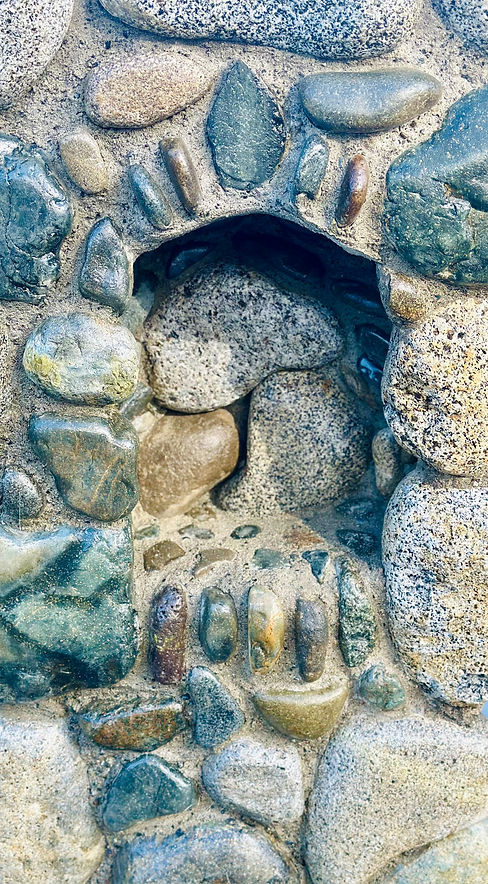
Aesthetic compatibility — the valley’s rural character, Garry oak ecosystems, and heritage properties all lend themselves to natural stone rather than the manufactured concrete block or poured concrete retaining systems that dominate urban landscapes. A well-built stone wall looks like it belongs in this landscape because, in many cases, it literally does — sourced from local quarries and fieldstone that reflect the regional geology.
Longevity — a properly built stone retaining wall outlasts virtually every alternative. Timber walls rot. Concrete block walls crack. Natural stone walls, built with appropriate drainage and foundation depth, can stand for a century or more with minimal intervention.
Drainage performance — dry-stone walls in particular are inherently permeable, allowing water to move freely through the wall rather than building hydrostatic pressure behind it. In a high-rainfall environment like the Cowichan Valley, this characteristic is a significant structural advantage over impermeable wall systems.
Property value — natural stone is consistently identified as one of the highest return-on- investment landscape features in residential property valuations. On rural acreage
properties in the Cowichan Valley, a well-executed stone wall installation adds visible and appraised value.


PART TWO: TYPES OF STONE RETAINING WALLS
Understanding the difference between wall types helps you make informed decisions about what’s appropriate for your property and budget.
Dry-Stone Walls
A dry-stone wall is built without mortar — stones are carefully selected and placed so that their weight, geometry, and interlocking arrangement provide structural stability. Dry-stone is one of humanity’s oldest construction traditions and some of the world’s oldest surviving structures are dry-stone walls.
Advantages:
-
Inherently permeable — water drains freely through the wall, eliminating hydrostatic pressure
-
Flexible — the wall can move slightly with freeze-thaw cycles and soil movement without cracking
-
Self-draining — no need for additional drainage infrastructure behind the wall in most applications
-
Visually authentic — the natural, unmortered aesthetic suits rural Cowichan Valley properties particularly well
-
Repairable — individual stones can be reset without disturbing the rest of the wall
Limitations:
-
Requires skilled craftsmanship to build properly — a dry-stone wall built without understanding of batter, tie stones, and proper stone selection will fail
-
Generally limited to walls under approximately 1.2 metres in height for purely residential landscape applications without engineering input
-
Not appropriate where the retained material includes significant hydrostatic pressure from underground water sources
Best applications in the Cowichan Valley: Garden terracing, property boundary walls, low landscape retaining walls, feature walls on rural properties, wall restoration where original dry-stone construction is being repaired.
Mortared Stone Walls
Advantages:
-
Greater structural strength for taller walls
-
More appropriate for walls supporting significant loads
-
Provides a cleaner, more formal aesthetic where desired
-
More resistant to displacement from impact or heavy soil pressure
Limitations:
-
Requires proper drainage infrastructure behind the wall — weep holes or perforated drainage pipe — because the wall itself is impermeable
-
Less flexible than dry-stone — more vulnerable to cracking from soil movement or frost heave if drainage is inadequate
-
More difficult to repair — mortar repairs must be colour and composition matched to the original
Mortar specification matters enormously For stone walls in the Cowichan Valley, mortar specification is not a detail to leave to a contractor’s discretion. The mortar must be
compatible with the stone type — a mortar that is too hard relative to the stone will cause the stone face to spall as thermal and moisture movement is absorbed by the stone rather than the mortar joint. At Lennox Masonry we assess the stone type and exposure conditions before specifying mortar composition for every project.
Best applications in the Cowichan Valley:
Taller structural retaining walls, walls adjacent to driveways or structures, formal garden walls, walls requiring a more refined finished appearance.
PART THREE: THE CRITICAL ROLE OF DRAINAGE
No discussion of stone retaining walls is complete without a thorough treatment of drainage — because inadequate drainage is the single most common cause of retaining wall failure, regardless of how well the wall itself was built.
Why Drainage Fails Walls
A retaining wall holds back not just soil but the water that saturates that soil. When rainfall saturates the retained material, hydrostatic pressure builds behind the wall. In a properly drained installation this pressure is relieved — water escapes through or around the wall before pressure reaches damaging levels. In a poorly drained installation that pressure accumulates until something gives — typically the wall.
The Cowichan Valley’s rainfall patterns make this particularly relevant. Extended periods of heavy rain — common from October through March — can saturate hillside soils
significantly. A wall with inadequate drainage that handles moderate rainfall adequately may
fail during an unusually wet season because the drainage system cannot keep pace with the water volume.
Drainage Solutions for Stone Retaining Walls
For dry-stone walls:
The inherent permeability of dry-stone construction provides natural
drainage in most residential landscape applications. However, on properties with high water tables, significant underground seepage, or slopes that concentrate water flow,
supplementary drainage — typically a perforated pipe in a gravel bed at the base of the wall — is still recommended.
For mortared stone walls:
Drainage is not optional for mortared walls — it is a structural requirement.
Every mortared retaining wall needs:
-
Weep holes — openings through the base of the wall at regular intervals that allow water to escape. Weep holes should be spaced at no more than 1.8 metres apart and positioned at the lowest practical point in the wall
-
Drainage aggregate — a zone of clean, free-draining gravel or crushed rock directly behind the wall to collect and direct water toward the weep holes
-
Filter fabric — geotextile fabric between the drainage aggregate and the retained soil to prevent fine soil particles from migrating into the drainage layer and eventually blocking it
Grading and surface drainage:
How water reaches the wall matters as much as how it leaves. Where possible, surface grading should direct water away from the top of a retaining wall rather than toward it. Paved or hardscaped areas directly upslope of a wall concentrate surface runoff significantly — this needs to be accounted for in drainage design.


PART FOUR: FOUNDATIONS AND STRUCTURAL
CONSIDERATIONS
Foundation Depth
One of the most common failures in amateur or under-qualified retaining wall construction is insufficient foundation depth. A wall built on the surface or with minimal foundation embedment is vulnerable to forward rotation — the base is pushed forward by soil pressure
while the top remains in place, causing the wall to lean and eventually fall.
As a general principle, retaining walls should be embedded into stable ground to a depth proportional to their height. For walls in frost-affected soils — which includes most
Cowichan Valley hillside properties — the foundation must extend below the frost line to prevent frost heave from displacing the base. The specific depth depends on site
conditions, soil type, and wall height.
Batter
Batter refers to the intentional backward lean of a retaining wall — the wall face angles slightly into the retained material rather than standing perfectly vertical. Batter is both a
structural and aesthetic characteristic of well-built stone retaining walls. It increases the wall’s resistance to overturning by shifting the centre of gravity back toward the retained material.
A wall with insufficient batter or no batter at all is more vulnerable to forward rotation over time, particularly as the retained material settles and shifts.
Tie Stones and Through Stones
In both dry-stone and mortared construction, stones that run the full depth of the wall — perpendicular to the face — are essential to structural integrity. These tie stones or through stones bind the front and back of the wall together, preventing the wall from splitting apart under soil pressure. Their omission is a common deficiency in poorly built stone walls.
When Engineering Is Required
For walls over approximately 1 metre in height retaining saturated or unstable soils, walls adjacent to structures or driveways, walls on properties with documented soil instability, or walls in areas subject to seismic activity — professional engineering input is appropriate and in some cases required by the BC Building Code. Your contractor should advise you when the scope of a retaining wall project warrants engineering review.
PART FIVE: WARNING SIGNS IN EXISTING WALLS
If you have an existing stone retaining wall on your Cowichan Valley property, the following
signs indicate it needs professional assessment.
Signs of Active Failure
Forward leaning or bulging:
Any visible forward lean or bulge in the wall face indicates that soil pressure is overcoming the wall’s structural resistance. This is a progressive condition — a leaning wall will continue to lean until it fails. It should be assessed promptly.
Separation at the base:
A gap opening between the base of the wall and the surrounding ground indicates the wall is rotating forward. This is an advanced warning sign of imminent failure.
Displaced or fallen stones:
Individual stones that have shifted, fallen, or been displaced indicate that the structural integrity of that section of wall is compromised. What appears to be a localized issue often reflects a more systemic drainage or foundation problem.
Settlement behind the wall:
Soil settlement or sinkholes behind the wall indicate that material is migrating through or under the wall — typically a sign of drainage failure where fine soil particles are being washed out through the wall structure.
Signs Warranting Monitoring or Maintenance
Vegetation growing in mortar joints:
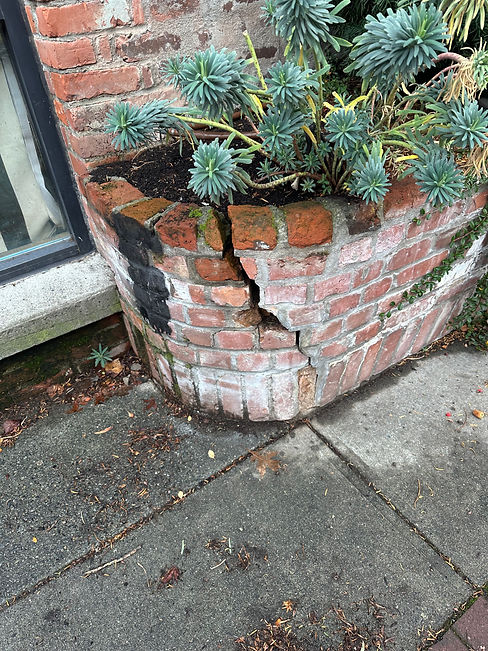
Plants rooting in mortar joints introduce root systems that expand cracks and progressively damage mortar. Vegetation should be removed and affected joints repointed before root damage advances.
Moss and lichen growth:
Organic growth on stone wall faces retains moisture and accelerates deterioration. It can be treated with appropriate biocidal washes without damaging the stone.
Efflorescence:
White mineral deposits on the wall face indicate water movement through the masonry — a sign that drainage may be inadequate or mortar joints are admitting water.
Minor mortar joint deterioration:
Isolated crumbling or missing mortar joints in a mortared wall should be repointed before water infiltration causes broader damage.
PART SIX: PLANNING YOUR STONE RETAINING WALL PROJECT
Choosing the Right Stone
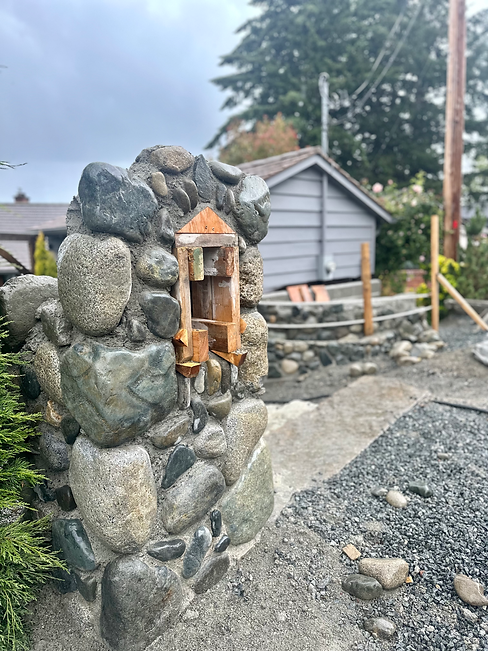
Stone selection is one of the most important decisions in a retaining wall project — both for structural compatibility and aesthetic outcome. In the Cowichan Valley, commonly used
stones include:
Local fieldstone — readily available, naturally suited to the valley aesthetic, variable in quality and shape requiring skilled selection
Basalt — dense, durable, dark in colour, suits contemporary and naturalistic designs, sourced from Vancouver Island and mainland BC quarries
Granite — extremely durable, available in a range of colours, suits formal and informal applications, typically quarried from mainland BC
Sandstone — warm toned, relatively soft, appropriate for decorative and low-load applications, used extensively in heritage construction including Duncan City Hall
Limestone — excellent workability, warm appearance, requires careful mortar specification to avoid staining
Ledgestone and quarried flagstone — angular, flat-faced stone that builds quickly and cleanly, suits contemporary applications.
The right stone for your project depends on the wall’s structural requirements, its visual context, your budget, and local availability. We discuss stone options with every client during the consultation process and can source materials appropriate to your specific project.
Permits and Regulations in the Cowichan Valley
Retaining wall requirements under the BC Building Code and North Cowichan or other municipal bylaws vary by wall height, location, and proximity to property lines and structures.
As a general guide:
-
Walls under 1.2 metres in height typically do not require a building permit in most jurisdictions.
-
Walls over 1.2 metres may require a permit and in some cases engineered drawings
-
Walls within setback distances from property lines may require additional approvals
We recommend confirming permit requirements with North Cowichan’s Building Department or the relevant municipal authority for your property before proceeding with any significant retaining wall project. Your contractor should be familiar with local requirements — at Lennox Masonry we advise clients on permit requirements as part of our consultation process.
What to Expect from a Professional Quote
A professional quote for a stone retaining wall project should include:
-
A site visit and assessment of existing conditions
-
Confirmation of foundation requirements based on soil conditions and wall height
-
Clear specification of stone type, mortar composition where applicable, and drainage approach
-
Itemised scope of work including excavation, foundation preparation, drainage installation, wall construction, and site restoration
-
Timeline and payment schedule
-
WorkSafeBC coverage confirmation and liability insurance certificate
Be cautious of quotes provided without a site visit, quotes that don’t address drainage specifically, or quotes significantly below market range — retaining walls are structural elements and under-priced work almost always reflects shortcuts in foundation depth, drainage, or material quality.
PART SEVEN: REPAIRING EXISTING STONE WALLS
When Repair Is Appropriate
Repair is appropriate when the wall’s structure is fundamentally sound but localised issues — displaced stones, deteriorated mortar, minor leaning — need to be addressed before they progress. Catching retaining wall problems early almost always results in lower repair costs than waiting for more advanced failure.
When Replacement Is More Economical
Walls that are significantly out of plumb, have failed drainage systems, have inadequate original foundations, or have sustained widespread stone displacement often cost more to repair correctly than to rebuild. A rebuild also provides the opportunity to address the root cause of failure — typically drainage — rather than simply restoring the wall’s appearance while the underlying problem continues.
At Lennox Masonry we give clients honest assessments of whether repair or replacement is the better investment. We do not have a financial interest in recommending a rebuild over a repair — we are equally prepared to do either and will tell you which makes more sense for your specific situation.
Matching Existing Stone and Mortar
When repairing an existing stone wall, matching the existing stone as closely as possible maintains visual continuity. This is particularly important on heritage properties or walls that form a prominent landscape feature. Mortar repairs must also be matched to the existing
mortar in colour, texture, and composition — a visually mismatched repair is often worse aesthetically than the original damage.


PART EIGHT: FREQUENTLY ASKED QUESTIONS
How much does a stone retaining wall cost in the Cowichan Valley?
Stone retaining wall costs vary significantly based on wall height, length, stone type, drainage requirements, site accessibility, and foundation conditions. As a general guide, professionally built stone retaining walls range from approximately $250 to $600 per linear metre for standard residential applications, with heritage or complex projects outside this range. We provide free on-site assessments and detailed written quotes for all projects.
How long does a stone retaining wall last?
A properly built stone retaining wall with adequate drainage and appropriate foundation depth can last a century or more. The limiting factors are typically drainage failure, inadequate original construction, or tree root intrusion — not the stone itself.
Can I build a stone retaining wall myself?
Small, low dry-stone garden walls are within the capability of a capable DIYer with patience and good reference material. Structural retaining walls — particularly mortared walls, walls over 60-70cm in height, and any wall retaining saturated soil on a slope — should be built by a qualified stonemason. The consequences of retaining wall failure include property damage, liability exposure, and in extreme cases personal injury.
Do I need a permit for a retaining wall in North Cowichan?
Generally, walls under 1.2 metres do not require a permit in most Cowichan Valley jurisdictions. Taller walls, walls near property lines, and walls on slopes may require permits and engineered drawings. We advise on permit requirements during our consultation process.
What is the best stone for a retaining wall in the Cowichan Valley?
There is no single best answer — it depends on the application, aesthetic preference, and budget. Basalt and granite offer exceptional durability for structural applications. Local fieldstone suits informal and naturalistic designs. We discuss stone options with every client and can provide samples and references for any material we recommend.
My retaining wall is leaning — is it going to fall?
A leaning wall may be stable for years or may fail relatively quickly depending on the degree of lean, the quality of the original construction, drainage conditions, and soil type. It should be assessed by a professional before the next significant rainfall season. If the lean is significant or accelerating, address it promptly.
Can a stone retaining wall be built in winter in the Cowichan Valley?
Mortared stone work should not be performed in freezing temperatures as mortar requires adequate temperature to cure properly. Dry-stone work can proceed in cooler weather. In the Cowichan Valley’s mild climate, most of the winter season is workable for dry-stone, with mortared work generally best planned for April through October.
CONCLUSION
A stone retaining wall is one of the most enduring investments a Cowichan Valley homeowner can make. When it’s right — well-founded, properly drained, built with stone that suits the site — it becomes a feature that defines the property for generations. When it’s wrong, it becomes an expensive problem that typically costs more to fix than it would have cost to build correctly the first time.
Lennox Masonry builds and repairs stone retaining walls throughout the Cowichan Valley from our Cobble Hill location. We work with residential homeowners, acreage property owners, and strata corporations across Cobble Hill, Mill Bay, Shawnigan Lake, Duncan, Maple Bay, Cowichan Bay, Lake Cowichan, Chemainus, and Ladysmith. Every project begins with a free on-site assessment and a clear, detailed written quote.
If you have a retaining wall project in mind — new construction, repair, or assessment of an existing wall — we’d be glad to take a look.
Lennox Masonry Ltd
Cobble Hill Location: 1265 Hutchinson Road, Cobble Hill, BC
Phone: 250-986-0324
Email: sean@lennoxmasonry.com
Website: www.lennoxmasonry.com/cobble-hill-masonry
Serving Cobble Hill, Mill Bay, Shawnigan Lake, Duncan, Maple Bay, Cowichan Bay, Lake Cowichan, Chemainus, and Ladysmith.
